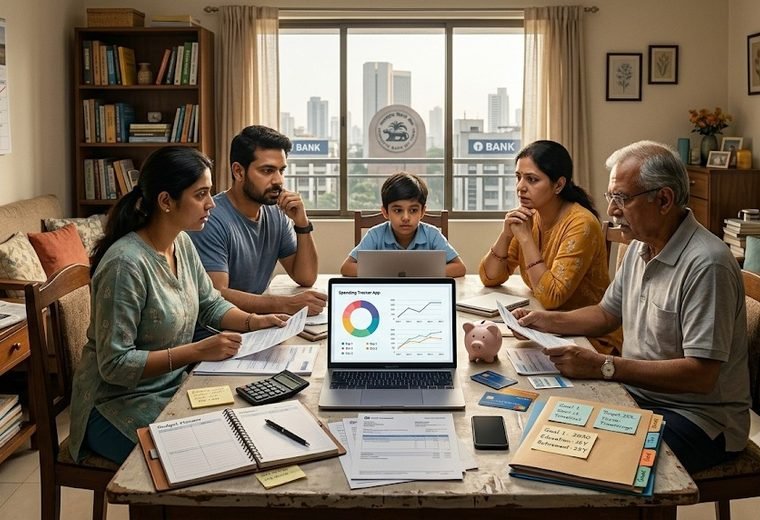
Financial news India readers had a rare piece of news on 7 October. The RBI’s Monetary Policy Committee voted to raise the repo rate by 25 basis points to 5.50%, the first hike since February 2023. For most households, a decision made in a Mumbai meeting room shows up weeks later as a changed EMI, a different fixed deposit rate or a wobble in a debt fund.
That’s what makes personal finance feel different now. It used to be a tax-season chore. Today, interest rate changes, inflation and market swings reach family budgets faster than ever, and the people who cope best aren’t the ones who predict them, they’re the ones who built a sturdy plan beforehand.
Why financial literacy matters
Financial literacy isn’t about knowing jargon. It means understanding what comes in, what goes out, what you owe and what you pay in fees.
Take two colleagues on the same salary, a hypothetical pair. One tracks spending, keeps six months of expenses in reserve and reads loan terms before signing. The other spends what’s left each month and finds out about charges when the statement arrives. After ten years, their incomes are identical and their outcomes aren’t. The difference is financial planning habits, not intelligence.
Discipline builds slowly: review your accounts weekly, ask what any product really costs, and be sceptical of anything promising high returns without risk.
Personal finance strategies for better money management
Budgeting and saving
Budgeting and saving works best when the budget reflects your life. Suppose a household takes home ₹85,000 a month, a hypothetical example. Rent, groceries, utilities, school fees and transport come to ₹42,000. An EMI takes ₹18,000. That leaves ₹25,000 for everything else. If you’re in that position, decide the savings figure first, say ₹12,000, and automate it for payday. The rest is for living.
Good money management is mostly deciding in advance, so you aren’t deciding under pressure.
Emergency fund planning
Keep three to six months of essential expenses somewhere you can reach quickly, such as a savings account or a liquid fund. For the household above, six months of essentials plus the EMI is ₹3.6 lakh. People with irregular income should lean to the higher end. The fund exists so a job loss or hospital bill doesn’t force you into selling investments or borrowing expensively.
Loans and credit
A common guideline is to keep total EMIs under about 40% of take-home income. The recent hike makes this more than a theory. If your home loan is linked to the repo rate, your lender may raise your EMI or stretch the tenure. Ask which one, and by how much. On credit cards, pay the full bill each month, since interest on unpaid balances is steep.
Investment trends in India
Investment trends in India have shifted toward regular, automated investing. Mutual fund investments through SIPs let people put in a fixed amount monthly, buying more units when prices dip and fewer when they rise, without having to time anything.
Participation in equity has grown, and so has the noise around it. For a sense of where stock market developments stand, the Sensex closed at 81,106.65 and the Nifty 50 at 25,044.65 on 10 November, with the Nifty holding above the 25,000 mark. Treat that as a snapshot. It will have changed by the time you read it.
The primary market has been busy as well. Indian companies raised a record ₹40,355 crore through 32 mainboard IPOs in September 2026, according to SEBI. Enthusiasm is fine, but each issue needs its own research. Long-term investment planning works better when you pick investments for your goals, not because a market is hot.
Wealth management is a grand term for a simple idea: keeping track of everything you own and owe, and arranging it so your assets work toward your goals while risks stay manageable.
Understanding market developments
The Indian financial market moves on a handful of forces, and a few of them are worth knowing.
Interest rate changes matter most this autumn. After the hike, floating-rate loans may cost more, and fixed deposit rates could rise over time, though banks adjust at different speeds. Bond and debt fund prices usually fall when rates rise, so check what you hold. Banking and financial services will respond to a higher-rate world by repricing loans and deposits.
Economic indicators give context. GDP grew 7.8% in the first quarter of FY2026-27. The RBI expects inflation of 5.2% for the year. Strong growth with rising inflation is a mixed signal, and it helps explain why the RBI tightened.
Then there’s sentiment, the market’s mood. It can change faster than company earnings, which is why a headline-driven selloff doesn’t always mean something is broken.
Diversification and financial risk management
Portfolio diversification means not putting everything in one share, sector or asset type. A mix of equity funds, debt and perhaps some gold softens the blow when one part falls. It doesn’t prevent losses, but it stops one bad bet from ruining a decade of saving.
Financial risk management goes beyond the portfolio. It covers insurance, which protects against large losses that investing can’t. A term plan if others depend on your income, and a health cover that matches medical costs where you live, are the basics. Keep insurance separate from investment, since products that blend them often do both poorly.
Volatility is the cost of owning equities. They can fall 10% or 20% even in healthy long-term uptrends. Match what you invest to when you need the money. Anything needed within three years shouldn’t sit in shares.
Retirement planning and tax-saving strategies
Retirement planning works because time does most of the work. A hypothetical example: ₹15,000 invested every month for 25 years comes to ₹45 lakh of your own money. If it grew at an assumed 7% a year, it would reach roughly ₹1.2 crore, and at an assumed 9%, roughly ₹1.7 crore. Those are illustrations, not forecasts, and equity returns vary a lot. The takeaway is that starting early beats searching for a clever product.
Use EPF, NPS and equity mutual funds together if they suit you. Review the plan once a year, and after any big life change.
For tax-saving strategies, choose products because they fit your goals, not because March is here. Which tax regime benefits you depends on your deductions. Compare both with real numbers, and check current limits with the Income Tax Department or a chartered accountant, since rules change.
Staying informed through reliable financial news
Accurate financial news India coverage helps you understand rate decisions, market moves and policy changes without panic. Reliable sources name their data, separate fact from opinion and correct errors. Cross-check anything that affects your money against the RBI, SEBI or the exchanges.
For readers who want market, business and financial developments in one place, Malik Times Financial News offers additional coverage. Malik Times also runs a Malik Times Personal Finance section for readers focused on household money topics.
Conclusion
The RBI’s rate hike is a reminder that your personal finance plan has to survive changing conditions. Build the emergency fund, keep EMIs manageable, diversify, invest regularly and review your goals once a year. Follow financial news India coverage for context, not as a signal to trade, and give good decisions time to work.
Quick answers
How does an RBI rate hike affect personal finance?
It can raise EMIs on floating-rate loans and may lift deposit rates over time. Debt fund prices often dip when rates rise.
How much should I keep in an emergency fund?
Three to six months of essential expenses is a common guideline, with more for irregular incomes.
What is the best way to start investing?
Many people begin with a monthly SIP in a diversified fund, after building an emergency fund and basic insurance.
Where can I follow reliable financial news in India?
Use official sources such as the RBI and SEBI alongside reputable media, and compare more than one outlet.