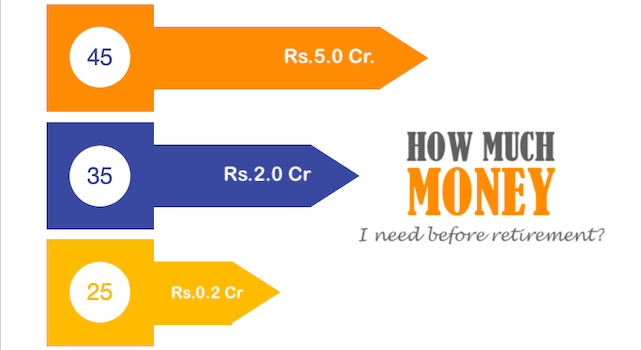
A relative recently told me his retirement plan was “whatever’s left in my PF account.” That’s not really a plan — it’s a hope. Figuring out how much money to retire comfortably requires actual numbers, not vague optimism, and honestly, most people avoid this calculation because it feels intimidating.
Why a Single “Magic Number” Doesn’t Really Exist
You’ll see figures like “1 crore” or “5 crore” thrown around online, but these mean nothing without context — your current age, expected lifestyle, inflation, and life expectancy all shift the real number dramatically.
A commonly used framework suggests you need roughly 25-30 times your annual expenses saved by retirement age, assuming a 4% safe withdrawal rate — though this should be adjusted upward for longer life expectancy and India’s relatively higher inflation compared to Western economies.
The 25x Rule, Explained Simply
If your annual expenses in retirement (in today’s value) would be ₹6 lakh, multiplying by 25 gives a target corpus of ₹1.5 crore. This is based on the idea that withdrawing roughly 4% annually from this corpus should sustain you without depleting it too quickly, assuming reasonable investment returns during retirement.
Why This Number Needs Adjustment for India
- Inflation in India typically runs higher (6-7% historically) than in developed economies where the 4% rule originated
- Healthcare inflation specifically runs even higher (10-14%), a significant retirement expense
- Life expectancy is increasing, meaning your corpus may need to last 25-30 years post-retirement, not 15-20
Given these factors, many financial planners in India suggest targeting 30-35x annual expenses rather than the standard 25x, to build in a safety margin.
A Realistic Calculation Example
Picture someone currently 35 years old, planning to retire at 60, with current annual expenses of ₹8 lakh. Adjusting for inflation over 25 years at 6% annually, their expenses at retirement (in future value) would be roughly ₹34 lakh per year. Applying a 30x multiplier, their target retirement corpus would be approximately ₹10.2 crore — a number that sounds enormous today but reflects the reality of long-term inflation.
[link to related guide about best retirement investment options here]
Working Backward: How Much to Save Monthly
Once you have a target corpus, work backward to figure out required monthly savings. Using the example above, saving consistently through equity-heavy mutual fund SIPs averaging 12% annual returns over 25 years would require roughly ₹65,000-70,000 monthly — a number that underscores why starting early matters so much.
Don’t Forget These Often-Overlooked Factors
- Healthcare costs typically rise sharply after age 60
- Any existing pension, EPF, or NPS corpus should be factored in and subtracted from your target
- Whether you’ll still have a home loan or other debt post-retirement
- Lifestyle inflation — most people’s expenses don’t stay flat; they tend to creep up over decades
Should You Include Your House in This Calculation?
Generally, no — unless you specifically plan to downsize or sell it. Your primary residence provides shelter, not liquid retirement income, so most planners exclude it from the retirement corpus calculation.
Mistakes People Make Planning for Retirement
The biggest one I’ve seen repeatedly: underestimating how many years the corpus needs to last, assuming they’ll need money only until 75-80, when many people today are living well into their late 80s or beyond.
Suggested alt text: “Retirement savings growth chart showing corpus building over decades toward a target goal”
FAQ
How much money do I need to retire in India? It varies widely, but a common framework suggests 25-35 times your expected annual expenses at retirement, adjusted for inflation and healthcare costs.
What is the 4% withdrawal rule in retirement planning? It’s a guideline suggesting you can withdraw about 4% of your retirement corpus annually without depleting it too quickly, assuming reasonable investment returns continue.
Should I include my house value in my retirement corpus calculation? Generally no, unless you plan to sell or downsize it specifically to fund retirement expenses.
How does inflation affect my retirement number? Significantly — inflation compounds over decades, meaning your future expenses will be much higher than today’s, which is why future value calculations matter.
When should I start planning seriously for retirement? As early as possible — starting in your late 20s or early 30s dramatically reduces the monthly savings required compared to starting in your 40s.
Conclusion
Figuring out how much money to retire comfortably isn’t about picking a scary-sounding crore figure from the internet — it’s about running your own numbers based on your actual expenses, timeline, and inflation assumptions. It’s an uncomfortable calculation to do, sure, but it’s far better to know the real number now than to discover a shortfall at 58.